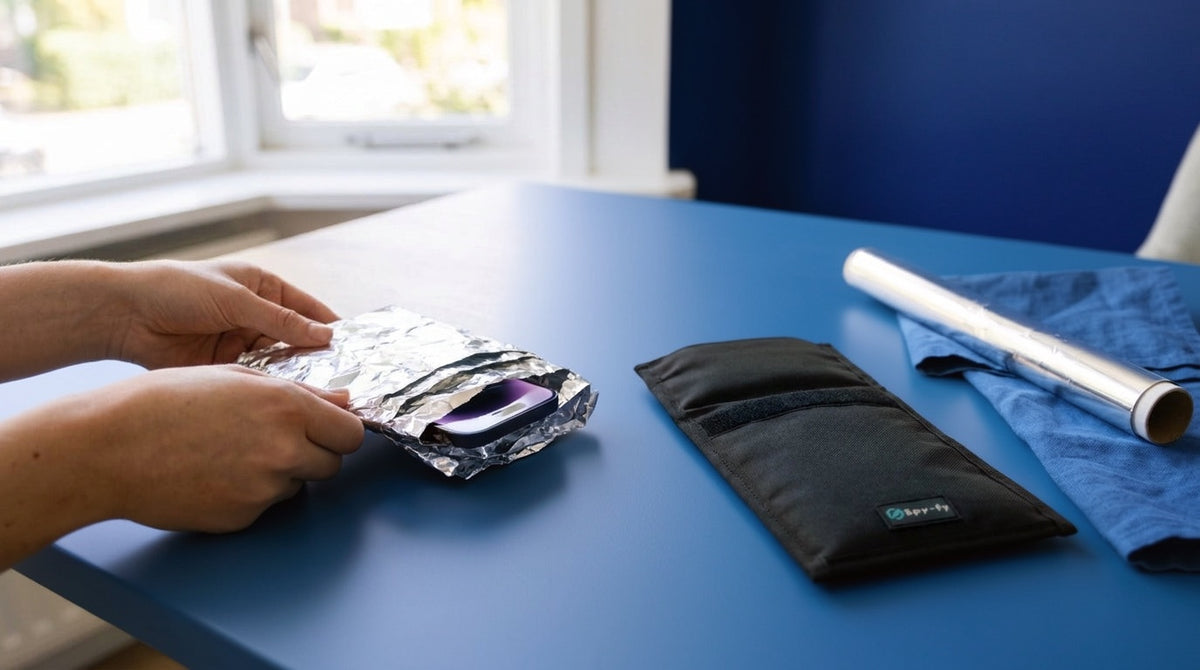
The honest answer to how to make a faraday bag at home is this: heavy-duty aluminum foil, wrapped around the device with every seam double-folded on all sides, is the only common household material that has measured well. Security researcher Matt Blaze recorded roughly 90 dB (decibels of attenuation, a measure of how far the signal strength is reduced) using exactly that method, which is in the same range as commercial pouches. He also found the result hard to reproduce: the same technique gave 90 dB in one test and only 50 dB in the next, because a single torn fold or an unsealed edge collapses the shielding.
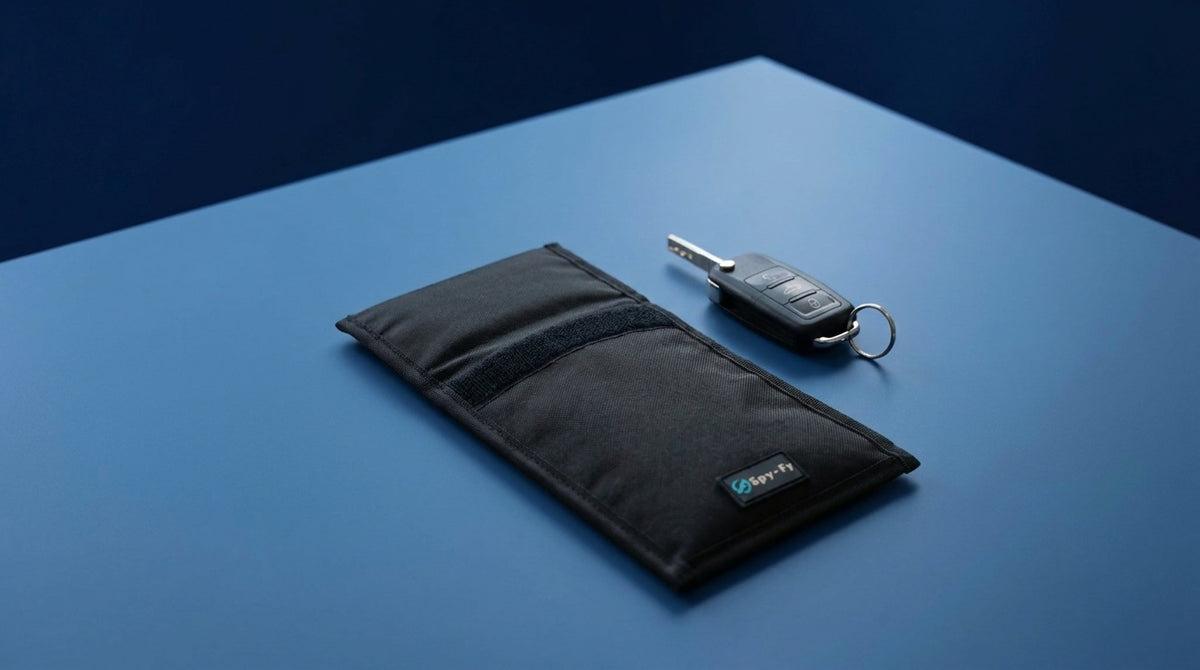
This matters most to a specific group of readers: executives carrying devices through unfamiliar travel environments, journalists who need a source meeting where no phone can transmit, attorneys protecting privileged conversations, and investigators following chain-of-custody procedure. For those use cases the question is not whether a homemade bag feels secure, it is whether you can prove it blocks signal. If your threat model is professional rather than experimental, a tested pouch from Spy-Fy's faraday bag range removes the variable you cannot control at home, which is the quality of your own seams.
Before any build instructions, that unit of measurement deserves more context. Attenuation in decibels is logarithmic: 20 dB is a factor of 10 in amplitude, 40 dB a factor of 100, 60 dB a factor of 1,000. At 80 dB, 1 volt of signal becomes 0.0001 volt. Blaze concluded that 80 to 90 dB is practically plenty, unless the phone is sitting within a few feet of a cell tower antenna. Keep that benchmark in mind, because almost every DIY material falls far below it.
What makes a faraday cage work
A faraday cage is any fully enclosing conductive shell with no unsealed gaps. The device inside must be surrounded on every side by a continuous conductive layer, and it must not touch that layer directly. There is no grounding wire involved in a portable build. What makes a pouch or wrap work is continuity of the shell and the tightness of the closure, not a connection to earth.
The basic build sequence is the same whether you are wrapping a phone, a key fob or a laptop:
- Insulate the device first. Wrap it in cloth, bubble wrap or a plastic bag so the conductive layer never contacts the housing or ports.
- Apply the conductive shell. Heavy-duty aluminum foil or nickel-copper ripstop fabric, covering every face of the package.
- Double-fold every seam. Fold each edge over on itself at least twice, on all sides. Single folds leave slot apertures that RF (radio frequency) energy passes straight through.
- Add a second layer, rotated. Orient the second wrap so its seams do not line up with the first.
- Test before you trust it. A build you have not verified is a guess, not a control.
The distinction between a rigid cage and a flexible pouch matters for how you store and use it, and the trade-offs are covered in more depth in Spy-Fy's breakdown of how a faraday cage differs from a faraday bag. A cage is static and durable. A bag travels, which means its closure takes mechanical abuse every single time you use it.
DIY faraday cage materials ranked by measured performance
Most DIY faraday cage materials perform far worse than their reputation suggests. Mylar bags and antistatic ESD (electrostatic discharge) bags never exceeded roughly 9 dB in Blaze's measurements, which is not usable shielding in any practical sense. A metal cookie tin did better but still fell short across the band, measured at 1 GHz (gigahertz), 2 GHz and 6 GHz.
| Material | Measured attenuation | Verdict |
|---|---|---|
| Mylar and antistatic ESD bags | Never above approximately 9 dB (Blaze) | Not usable shielding |
| Metal cookie tin | 38.8 dB at 1 GHz, 43.5 dB at 2 GHz, 28.8 dB at 6 GHz (Blaze) | Better than mylar, insufficient at every frequency tested |
| Galvanized steel trash can with lid | 34 dB cellular, 13 dB Wi-Fi in a comparative test published by a faraday bag manufacturer | Leaks badly on Wi-Fi frequencies |
| Heavy-duty aluminum foil, carefully double-folded | Approximately 90 dB in Blaze's best runs | Can reach commercial-pouch levels, difficult to reproduce |
Read that table against the 80 to 90 dB benchmark. A cookie tin at 43.5 dB is a factor of roughly 150 in amplitude reduction, which sounds impressive until you compare it against a figure roughly two orders of magnitude higher. The gap between "the phone shows fewer bars" and "the phone cannot reach a tower" is exactly where DIY builds tend to live.
Conductive fabric is the only DIY route with a serious ceiling, and it is also the most demanding to execute. Stitch holes are apertures. Thread that is not conductive leaves a seam line that behaves like a slot antenna. If you want to understand what commercial pouches are actually constructed from before you try to replicate it, Spy-Fy's guide to the materials used in faraday bags covers the layer structures and seam methods involved.
How to make a faraday box for storage
A faraday box is a rigid metal container with an overlapping, conductive lid seal. It is better suited to storage than to transport: key fobs by the front door, spare devices, backup drives. Build quality lives entirely in the lid, because a lid that merely rests on a rim leaves a continuous gap around the full circumference.
To improve a metal box, line the rim contact surface with conductive tape or conductive gasket material so the lid makes electrical contact around the entire edge rather than at a few high points. Line the interior with cloth or foam so the stored item does not rattle against bare metal. Then measure it, because the published numbers for tins and bins are discouraging and your box is not special until you have proof. A broader comparison of container types is set out in Spy-Fy's explainer on what a faraday box is and when to use one.
Two procedural warnings apply to boxes and bags alike, and both come from forensic practice. SWGDE (the Scientific Working Group on Digital Evidence), in best practice document 18-F-003 version 2.0 on mobile device evidence collection, warns that airplane mode in newer mobile operating systems does not always disable Bluetooth, Bluetooth Low Energy or Wi-Fi, and names an RF shielded enclosure as the alternative. Shielding drains the battery, because the device keeps searching for a signal, so power has to be maintained without breaching the shield: a cable must never run from the device inside the enclosure to a charger outside it. The same document states that RF shielding containers are not always fully effective and should be tested regularly. Separately, SWGDE's guidance on Internet of Things devices, document 22-F-001, warns that a disconnected battery must not be placed inside a shielded enclosure together with the device itself, because the enclosure can then form a connection or antenna path.
How to make a faraday bag from aluminum foil
Aluminum foil can work, and in careful hands it is the best household material by a wide margin. Blaze reached approximately 90 dB with heavy-duty foil by wrapping the source meticulously and double-folding the seams on all sides, comparable to commercial pouches. The claim that foil "always works" is false: Blaze's same technique produced 90 dB in one test and only 50 dB in the next, with no visible difference, and every tear, crease opening or single-folded edge ruins the result.
If you are going to use foil, use it properly:
- Use heavy-duty foil rather than the thin standard roll. Thin foil tears at the fold line.
- Wrap the insulated device completely, then fold each open edge over twice, pressing the crease flat.
- Apply a second complete wrap with seams rotated roughly 90 degrees from the first.
- Treat each wrap as single-use. Unwrapping work-hardens the folds and opens micro-tears.
- Verify it with the signal protocol below, every time, because "every time" is the only schedule that survives a new wrap job.
That last point is the real cost of foil. A build you must rewrap and re-verify on every use is fine for a one-off situation and unworkable as a daily habit for someone handling privileged material several times a week.
Where DIY bags fail
DIY bags fail at the closure and at anything passing through the shell. NIST (the National Institute of Standards and Technology), in Special Publication 800-101 Revision 1, gives three reasons shielding fails: materials that do not provide enough attenuation, leaks or seams in the shield, and the conductive shield acting as an antenna. It also warns that an improperly sealed bag, or a cable running from the device out of the bag, lets the device reach the cell network. The same guideline states plainly that a faraday container attenuates the radio signal but does not necessarily eliminate it, so communication with a nearby cell tower remains possible.
Three further realities break most homemade builds:
- Powering off is not a substitute. Apple documents that with Find My iPhone and the Find My network enabled, a supported iPhone (iPhone 11 and later models with Ultra Wideband) can be located for up to 24 hours after being switched off, and up to 5 hours in power reserve mode. On Android, Google's Find Hub network can locate supported devices such as the Pixel 8 series for hours after shutdown, provided Bluetooth and Location were on at power-off and offline finding is set to "With network in busy places only" or "With network everywhere".
- Modern phones carry more radios than your test covers. Flagship phones commonly ship with Wi-Fi 7, Bluetooth, Thread, ultra-wideband and satellite messaging alongside cellular. A bag you only checked against LTE (Long Term Evolution cellular) and Wi-Fi has not been shown to handle Thread, ultra-wideband or satellite bands. Current flagships make that gap concrete: the iPhone 18 Pro and iPhone 18 Pro Max carry Apple's N1 chip for Wi-Fi 7, Bluetooth 6 and Thread, a second-generation Ultra Wideband chip, the C2 cellular modem and satellite features for use outside cellular and Wi-Fi coverage. Each of those is a separate radio your pouch has to attenuate.
- Shielding degrades with handling. Fabric seams loosen, foil tears, hook-and-loop flaps collect lint and stop closing flat. A result you measured months ago is not a result you still have today.
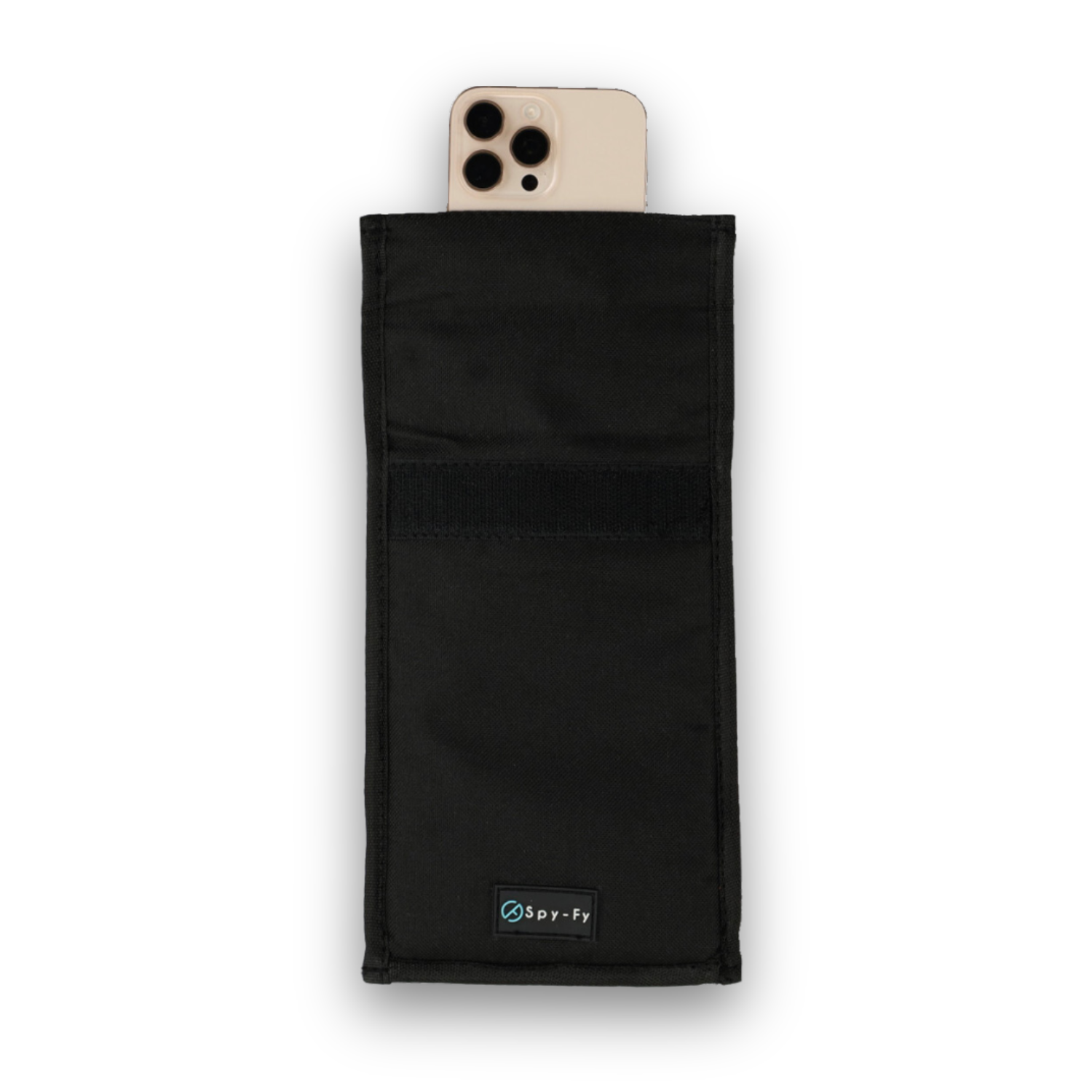
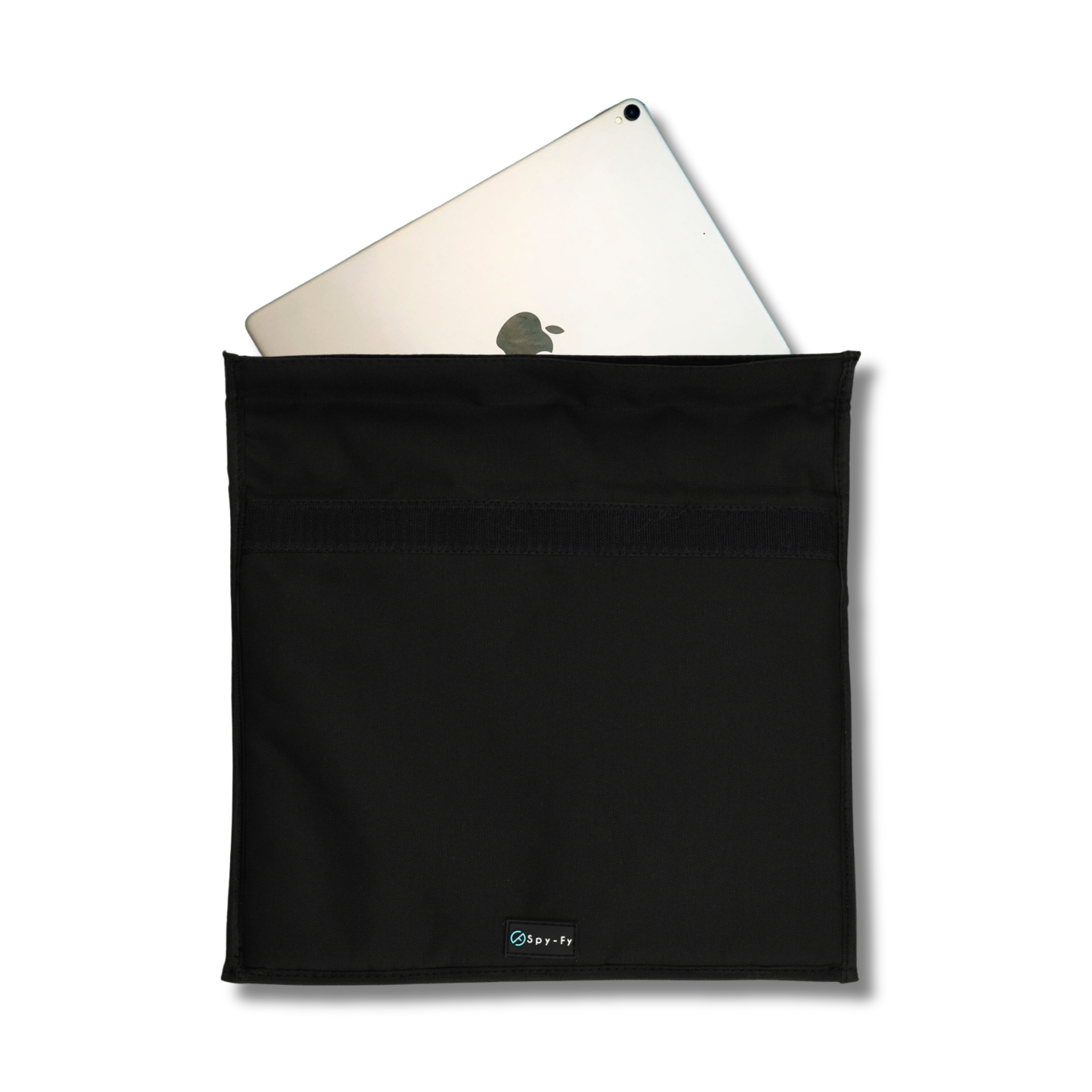
If the goal is a pouch you can grab and close without rebuilding it, Spy-Fy's faraday bag for phone, tablet and laptop comes in three sizes: phone at 12 x 19 cm (4.7 x 7.5 inches), tablet at 33 x 25 cm (13 x 9.8 inches) and laptop at 39.5 x 26 cm (15.6 x 10.2 inches). Spy-Fy publishes a lab figure for those bags: an average of 70 dB attenuation from 30 MHz to 6 GHz, measured by Applus+ Keystone, an ISO/IEC 17025 accredited lab, according to IEEE 299-2006. That is a number you can hold a vendor to, which is exactly what a home build cannot give you. Spy-Fy also states what the bags do not block: older 125 kHz low-frequency access badges, and sound. Any vendor claiming total blockage is overselling physics, because a shield attenuates a signal rather than erasing it.
How to make a faraday bag you can actually test
Testing one signal proves almost nothing, because different radios use different frequencies and an enclosure that blocks cellular can leak Wi-Fi. Run all five checks below, in order, on the exact device you intend to carry. Seal the bag the way you would in real use, not more carefully.
- Cellular. Call the device from another phone. It should not ring and should go to voicemail without delay.
- Wi-Fi. With the device on your network, ping it from a laptop before sealing, then again after. Replies should stop.
- Bluetooth. Attempt to pair or reconnect a known accessory. It should fail to discover the device.
- GPS (Global Positioning System). Open a mapping app before sealing, seal the bag, wait two minutes, then check whether the position still updates when you move.
- NFC (Near Field Communication) and contactless. Tap the sealed bag against a contactless reader or a card terminal. Nothing should register.
Blaze himself suggests a fast go/no-go check: place an AirTag inside the bag and see whether a nearby iPhone can still locate it and make it play a sound. That gives you a pass or fail rather than a decibel figure. Watch for cached location data in the Find My app, which shows a stale position that looks like a leak. Re-run the full five-signal protocol after any drop, after any visible wear on the closure, and on a fixed schedule such as the first day of each quarter.
What a homemade bag can never give you
No DIY build can produce a verified attenuation rating, and no DIY build can legitimately claim compliance with a standard. Those two gaps are structural, not a matter of effort.
The standards most often quoted in this category do not say what marketing copy implies. MIL-STD-188-125-1, where MIL-STD stands for Military Standard, covers high-altitude electromagnetic pulse hardening of fixed, ground-based C4I (command, control, communications, computers and intelligence) facilities, and part 2 covers transportable systems in shelters. Neither was written for phone pouches. IEEE (Institute of Electrical and Electronics Engineers) Std 299-2006 is a measurement method, written for shielding enclosures of 2 m or more in every dimension and frequencies from 9 kHz (kilohertz) to 18 GHz. The companion standard for enclosures between 0.1 m and 2 m, IEEE 299.1-2013, carries the status "Inactive-Reserved" at the IEEE Standards Association. These standards describe how to measure; they do not certify a pouch. So when a pouch claims "MIL-STD tested" or "IEEE 299 compliant", ask which lab, which document and which frequency range. Spy-Fy answers all three for its own bags: Applus+ Keystone, IEEE 299-2006, and 30 MHz to 40 GHz, with the test report available on request.
One legal point is worth being precise about for US readers. Passive shielding is legal. Active signal jamming is not: section 302(b) of the Communications Act of 1934 prohibits the manufacture, import, sale and offering of jammers, section 333 prohibits their use, and the FCC (Federal Communications Commission) states that jammers cannot be certified because interference is their intended function. Only the federal government may acquire and use them, in narrowly defined cases. A faraday bag puts a barrier around your own device. A jammer attacks the spectrum everyone else is using.
Cost is the last illusion. Conductive ripstop fabric, conductive thread, conductive tape and a seam-sealing method add up quickly, and a serious sewn build often lands near the price of a finished pouch with none of the quality control. For organizations buying in volume, Spy-Fy's custom faraday bags come plain from a single unit with volume pricing from 25 units, or with a printed logo from 25 units in all three sizes. Orders up to 100 units usually ship in about two weeks, larger orders in four to five weeks after design approval. Before you compare anything on price alone, it is worth reading what separates a well-built faraday bag from a cheap one, because the construction details that matter are not visible in a product photo.
The practical takeaway
Build one if you want to understand the physics, need an unusual size, or have a device in front of you and no pouch in the bag. Heavy-duty foil with double-folded seams on all sides is the method with real measured support behind it, and you should verify it across cellular, Wi-Fi, Bluetooth, GPS and NFC before you rely on it for anything that matters. What you cannot do is turn that build into a repeatable, auditable control, which is precisely what a journalist protecting a source, an attorney protecting privilege, or an examiner protecting a chain of custody needs.
If the device you are shielding costs over a thousand dollars and the information on it costs considerably more, the calculation is straightforward. Choose a pouch built to close the same way every time, test it yourself anyway, and keep your expectations grounded: attenuation, not elimination. Start with the sizes and construction details of Spy-Fy's faraday bags and pick the format that matches the device you actually carry.